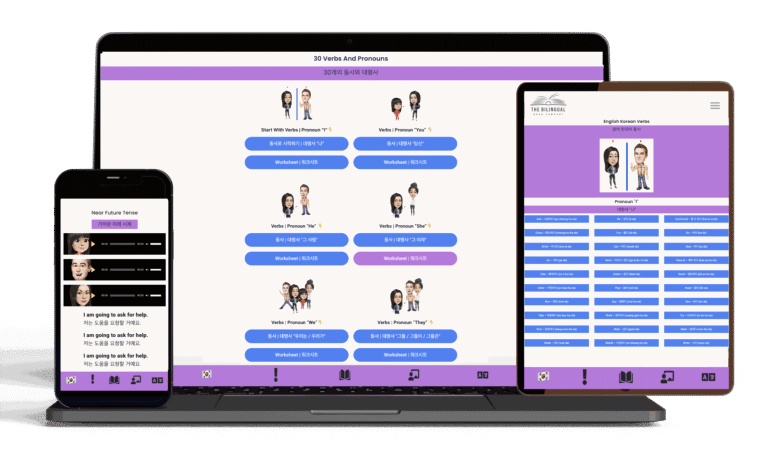
보고, 듣고, 따라 읽고, 써 보는 과정은 언어를 익히는 데 큰 도움이 돼요. 이 섹션에서는 반복되는 이중언어 문장을 보며 오디오를 듣고, 자연스럽게 따라 읽을 수 있어요. 일주일에 한 개의 동사를 배우고, 그 동사로 이루어진 간단한 다섯 문장을 각기 다른 대명사와 함께 연습해요. 제공된 간단한 워크시트를 활용해 반복해서 써 보면 어휘와 동사 활용을 더 오래 기억할 수 있어요. PDF는 컴퓨터나 휴대폰에 저장해 두실 수 있으며, 안에 30개 동사와 대명사 섹션으로 연결되는 링크도 포함되어 있어요. 이 프로그램은 멘사 테스트의 아이디어에서 영감을 받아 만들었어요. 멘사 시각 테스트는 패턴을 찾는 능력에 중점을 두는데, 시각 학습자인 앤젤린은 미래형·과거형·현재형 문장을 반복해서 보여 줌으로써 아이들이 동사 변화를 쉽게 이해할 수 있도록 이 구성을 만들었어요. 또한 실제 대화에 더 도움이 되도록 과거형은 한 가지 형태만, 미래형은 가까운 미래 표현만 학습하도록 단순화했어요.
앤젤린은 국제 멘사 회원으로, IQ 표준 검사에서 상위 1%에 해당하는 99.2%의 높은 점수를 받았어요. 그녀는 이 프로그램이 아이들에게 문제 해결의 기본 능력을 키워 준다고 믿고 있어요. 앤젤린은 “패턴을 알아보는 능력은 다음에 올 값을 예측하거나 계산할 수 있게 해 주는데, 이는 문제를 해결하는 데 꼭 필요한 과정이에요”라고 설명해요. 항공우주공학을 전공한 그녀는 현재 여가 시간에 컴퓨터 프로그래밍도 공부하고 있어요.
Look, Listen, Read Along, Out loud and Write! Look at repeated bilingual sentences. Listen to the bilingual audio and read along, out loud! Learn 1 verb a week by learning 5 simple sentences a week, 1 pronoun at a time! Students are encouraged to use the simple worksheet provided. Writing repeated lines helps students remember vocabulary and verb conjugation. Save the pdf to your computer or phone. There is a link on the PDFs for easy access to the 30 verbs and pronouns section!
This section was created by Angeline, inspired by Mensa intelligence tests. Mensa visual tests are based heavily on pattern recognition. As a visual learner herself, she decided to create a program where the student can see repeated sentences in the future, past and present tense. Repeated sentences with translation help kids and students recognize verb conjugation rules more clearly. She also streamlined this section such that students are only learning one form of the past tense and only one form of the future tense, the near future. This is more practical for kids in daily conversations.
Angeline is part of Mensa high IQ society, scoring 99.2%, or in the top 1% on standardized IQ tests. She believes her program helps kids develop foundational skills in problem solving. “Recognizing a pattern allows one to predict or calculate the next value of a sequence, a fundamental step in problem-solving.” Angeline holds a degree in Aerospace Engineering and is currently studying computer programming in her leisure time.