Angeline 是国际高智商组织 Mensa 的成员,在标准化 IQ 测试中取得了 99.2% 的成绩,位列全球前 1%。她相信,这套课程能够帮助孩子建立解决问题的基础能力。她常说:“能看出模式,就能推测或算出下一步会出现什么,这是培养思维能力的重要一步。”Angeline 拥有航空航天工程学位,平时也利用空闲时间继续学习计算机编程,不断丰富自己的知识背景。
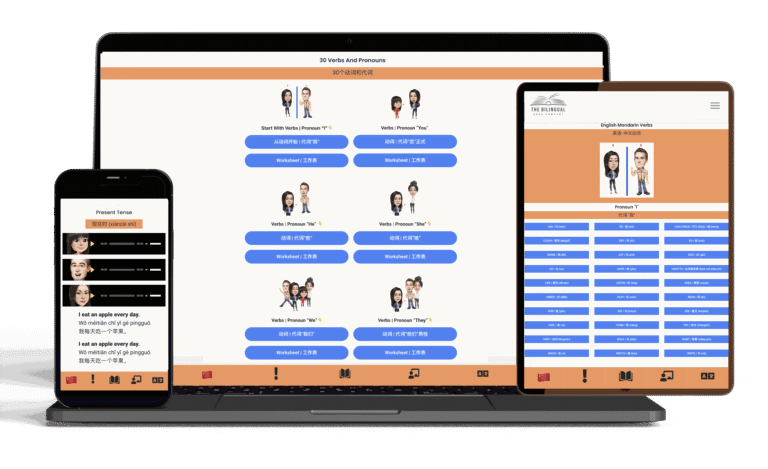
Look, Listen, Read Along, Out loud and Write! Look at repeated bilingual sentences. Listen to the bilingual audio and read along, out loud! Learn 1 verb a week by learning 5 simple sentences a week, 1 pronoun at a time! Students are encouraged to use the simple worksheet provided. Writing repeated lines helps students remember vocabulary and verb conjugation. Save the pdf to your computer or phone. There is a link on the PDFs for easy access to the 30 verbs and pronouns section!
This section was created by Angeline, inspired by Mensa intelligence tests. Mensa visual tests are based heavily on pattern recognition. As a visual learner herself, she decided to create a program where the student can see repeated sentences in the future, past and present tense. Repeated sentences with translation help kids and students recognize verb conjugation rules more clearly. She also streamlined this section such that students are only learning one form of the past tense and only one form of the future tense, the near future. This is more practical for kids in daily conversations.
Angeline is part of Mensa high IQ society, scoring 99.2%, or in the top 1% on standardized IQ tests. She believes her program helps kids develop foundational skills in problem solving. “Recognizing a pattern allows one to predict or calculate the next value of a sequence, a fundamental step in problem-solving.” Angeline holds a degree in Aerospace Engineering and is currently studying computer programming in her leisure time.